

Jesus Died
Reflecting on Holy Saturday and death and dying

We live on the other side of Jesus’s story, but on that Friday, roughly two thousand years ago, Jesus died. Evangelicals are traditionally resurrection people. Catholics carry or wear crucifixes because they connect to the mystery of the suffering of Christ. Protestants wear crosses without Jesus because they connect to the resurrection, but both pieces of the story are valid. I wonder if perhaps, evangelicals don’t spend enough time contemplating what is hard, of sitting in the grief of it all. It’s good to be resurrection people, but it’s a good posture to slow down and notice the middle places of the story, too.
On Friday (as a day starts at sundown the day before), Jesus wrestled with God in the Garden—it seems here that so much suffering occurred before the crucifixion. Then he was betrayed, jailed, placed on trial, mocked, abandoned by religious leaders, found innocent of a crime, but guilty for calling himself God’s son, beaten, cursed, hit on the head, forced to carry a cross in a weakened state, abandoned by his friends, nailed or tied to a cross, mocked by the soldiers, mocked by the criminals on crosses beside him, felt disconnected from the Father, stripped of his clothing, offered seven distinct words from the cross, and executed. There are a lot of bad days in the world, but it’s hard to imagine a day getting much worse than this. It just wasn’t good until Easter came.
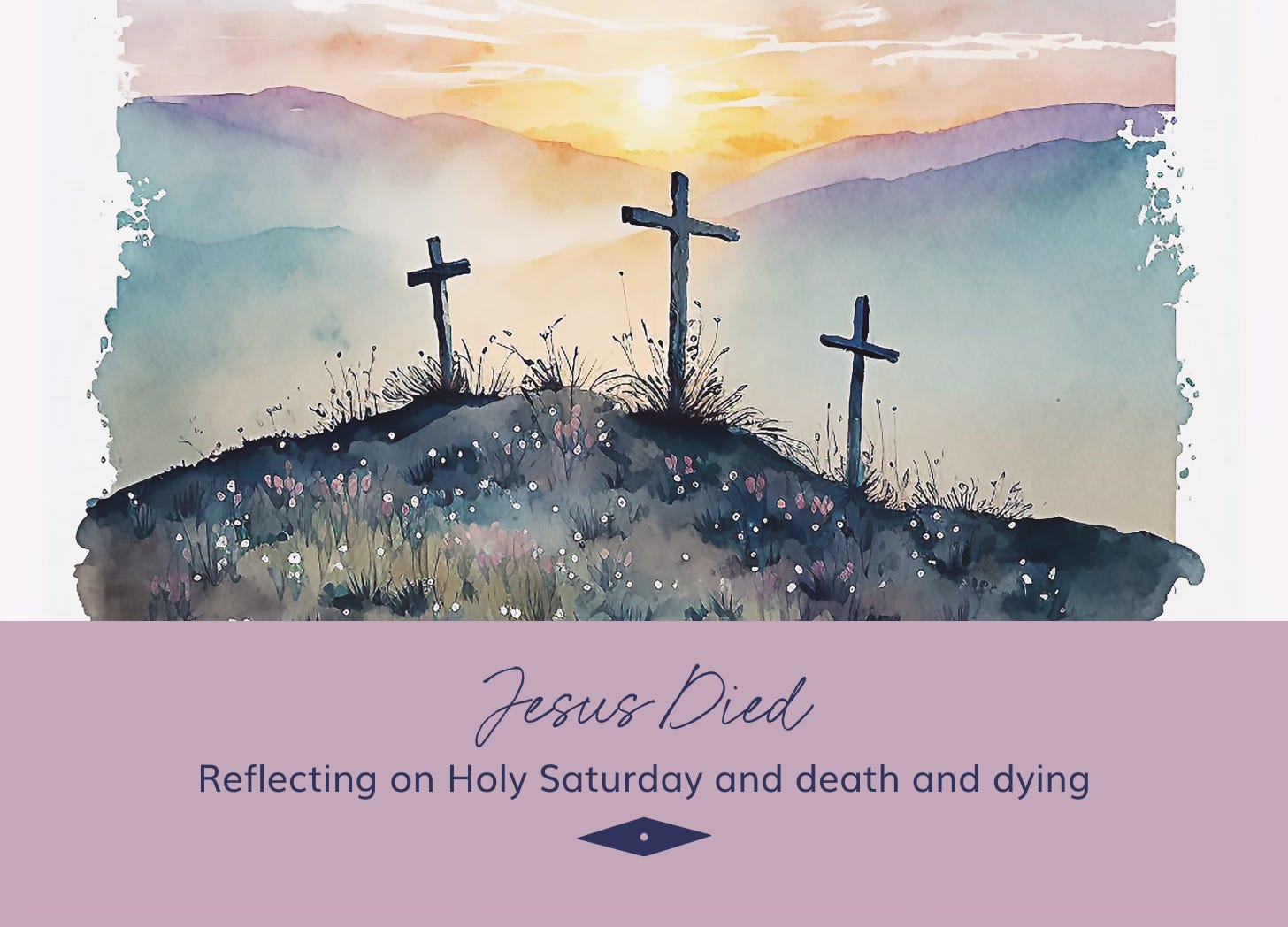
In the middle of the worst day, there are some graces: the women stay present to Jesus, John is there and promises to take care of his precious mother, Jesus dies quickly before the need to break his bones, Joseph of Arimathea goes to Pontius Pilate and asks to bury his body, and it is granted. Usually, those crucified are not buried - their bodies picked over by animals, the stench of death filling the air. He wraps Jesus’s body in linen and lays him in the tomb before the end of the day.
As Holy Saturday begins, Jesus is in the tomb, and it’s the Sabbath. Jesus is dead.
I’ve always felt a kinship with Holy Saturday: the waiting, the questions, the wondering where God is. Most of my story with God has been spent wrestling, questioning, waiting, wondering, and feeling lost. In recent years, I’ve moved from a chaotic wrestling to a deepening assurance of knowing who God is. It’s changed how I wrestle with God and how it feels. I feel a deep abiding awareness of the presence of God with me, even if there are days and times when I feel distant and farther from God. It does matter if I have dedicated time spent with God, but simultaneously, it doesn’t. God is present and with me wherever I go. I don’t think I am extraordinary, but I feel a sense of constant communion and connection to him because I am leaning into the contemplative with him. That constant feeling of with-ness with Jesus is not ordinary.
As a pilgrim of the Ignatian exercises, I’ve been walking through the Passion of Christ throughout the season of Lent. I’ve spent a week contemplating each day of Holy Week. This year, Holy Saturday hits a bit differently. It’s the death and grief I keep pondering - not just the death of Christ, but death period. Fairly early on in the exercises, we had to consider our own death, but it seems to hit me right here more than then.
In my midlife, I’m living vocationally, which means there’s more living from abundance. Trust me, abundance is nice, but it does not mean hard things are lacking. There are lots of tough things that I suffer through in abundance. Living from abundance does not mean that suffering disappears. It doesn’t. And, in midlife, I’m more aware that my days are numbered. I’m approaching 50 years, and my dad died two weeks shy of his 56th birthday. I carry a bit of trepidation, wondering if I will live longer than he did or die young too.
I’m facing a decision, and at the end of the decision, there is death (in literal and figurative ways). If I go down one path, I will be a changed person at the end of it. The other choice feels less risky, but the truth is that in midlife, life changes. Children grow up and leave home. Parents begin to be unwell. Family dynamics change. Each of these things is a tiny death, and I am, if honest, aware of a fear I haven’t had in a while. Depending on my fear, I can be apt to turn around rather than move forward into the fear. The disciples are familiar with turning around in the middle of fear.
I wonder what the disciples felt on Holy Saturday. Shame? Fear? Helplessness? Darkness? Sorrow? Deep grief? Did they remember Lazarus, newly resurrected? Did they think of Mary of Bethany’s anointing of the perfume? Were they able to put the pieces together and hope? We get some clues in the story that they don’t think about much hope on Holy Saturday, because when the women declare the resurrected Christ on Sunday, the disciples declare them delirious.1
David, sometimes considered a villain in today’s biblical narrative, was extraordinary. No doubt he does do some evil things - proof that we could do some of the same things. Despite missing the mark, His psalms show how much David knew the Lord. It’s evident that somewhere in his story, he pondered his own death and made peace with knowing that God would be there with him. How could he say, “even the darkness will be as light to you” 2 or “if I make my bed in the depths, you are there” 3 unless this were true? His trust in God is deep. He claims God is with us in our death. He’s not even on this side of the resurrection, which is something to marvel at despite how far he falls.
This week, as I listened to the Low in the Water podcast, Winn Collier said something profound:
I used to hear that in a way that was like, God is not around the dead things. That’s not what God is, because God is life, so God is always with the live things. And that not what it’s saying.
That’s not what the gospel as a whole is saying. The gospel is saying, God is not among the dead, not because God is not near death, but because God in Jesus Christ is so inside death that death can’t stay death anymore.
…
God couldn’t be any closer to death. He took all of it into his very body. He is so on the inside, he knows it so intimately. And death has no capacity to stay death when the Lord of Life enters. And so that’s why God is the God of the living, not the dead, because everything God touches ends up living. That’s good news.
What is left to fear if Jesus gets inside death and defeats it? What is scary about dying if Jesus himself knows death and dying? Knowing that Jesus is with us in our sorrows, endings, and beginnings is comforting. I think that no matter how low I feel or deep my grief is or, as in my case, how afraid I feel in the shadow of death or dying or of being with the dying, there is nothing to fear, for he is always with me - even, it seems, in death.
The disciples may not have known that they would find Jesus alive the next day. They may have felt confused, sorrowful, and all sorts of other things. I love that no matter what kind of story I am inside, Jesus has been there too, maybe even in a deeper way than I can understand or perceive.
I can hold the mix of looking down with the ability to look up. Being able to know that he is with me in the middle of these hard things - even death, loss, change, and the unknown — is good news indeed, even on Holy Saturday.
Luke 24:11
Psalm 139:12
Psalm 139:8
This is so beautiful and hopeful, Jamie. I'm looking forward to our chat when you have a moment to schedule it.