

Chaplaincy and CPE
what I'm doing in this season

Several months have passed since I last wrote anything here, and to be honest, I’m not sure how to begin again. I typically write from a place of spiritual formation, but this post won’t be intentionally formational for the audience; it will be reflective and, therefore, formational for me. I hope that it still benefits you all, too. I want to write a little bit to update you on what I am doing and to find myself again. There’s something about writing that feels like where I put what is honest and true about me, but in the last several years, I’ve been learning to embody my honest and authentic self, so that what is on the paper is what you find in person, too.
I’m in a season of deep transition and change. Two of my children have graduated and are attempting to learn how to be people on their own. I didn’t intentionally decide to remake myself around the idea of the second half of life, but it’s worked out that way for me, and what a pleasant surprise it has been. From graduate school to spiritual direction training to what I am doing now, I’m still figuring out what I want to be when I grow up. This leads me to an update I wanted to share: I am currently working as a chaplain resident at the level 1 trauma hospital in my state and going through what is known as CPE - clinical pastoral education.
I applied in February, interviewed a month later, and heard in April that I was accepted into the program. However, for a while, even though I accepted the offer into the program, I was unsure if I would do it. I was somewhat terrified. However, I started at the end of August and am almost halfway through the first unit. As a chaplain resident, I receive a stipend for the job portion of my work and also have educational fees to pay for the school portion.
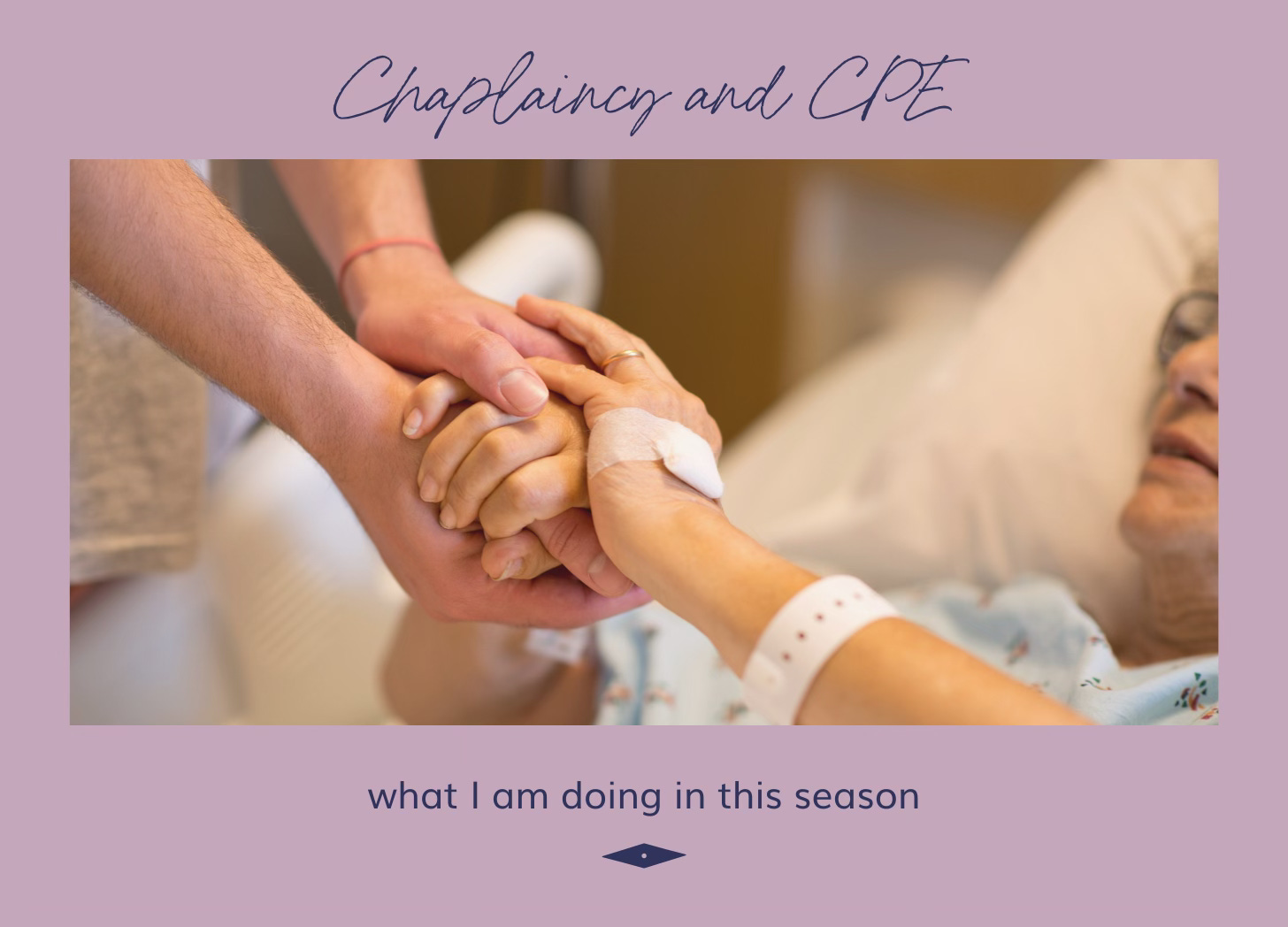
So, I'm going to tell you what I’m doing. I am working as a hospital chaplain, although I’m also still doing other chaplaincy and spiritual direction work, however minimally. I have four hospital units of my own, and if patients who need spiritual care come up on those units, those patients are mine. Currently, I have a (1) neurology, (2) nephrology, (3) head, neck, and plastics, and a (4) psych unit. Each unit has different challenges, but I love all of my units. I work during the week between 8 am and 4 pm on Monday-Thursday, but then I have a 12-hour weekend shift. My weekend shift could be from 7 am to 7 pm or vice versa. On the weekend shifts, I am “on call” and cover the whole hospital for emergent chaplain needs. This is the most challenging aspect of the job. If anyone codes or if someone dies, the chaplain on call is the one they call. If someone comes to visit someone who has passed, then I escort them to the morgue. Basically, I am learning to be with people in crisis at all times, but especially during the weekend shifts.
Chaplains provide emotional and spiritual care to any patient who desires to see one. A lot of times, people think of chaplains as the people who pray with them before surgery. We do that when requested, but we also assess people whenever we meet with them to determine what else they may need in terms of emotional or spiritual care. Very often, a nurse doesn’t have the time to listen to what a patient may need emotionally, so chaplains are called in. Most people in the hospital are in crisis, and most are grieving, even something as simple as not being able to wear their usual clothes. Just like a nurse, I may ask what someone’s pain level is, but also, we talk about their questions - does God care if I choose to die this way? Is it okay to terminate my loved one’s care? How do I know if I am saved? It is amazing the kinds of existential questions and concerns I hear daily.
In addition to my job responsibilities, I’m also a resident, which means several of my weekly hours are for “learning.” Even though I went through a spiritual formation graduate program and completed spiritual direction training, this type of “learning” is unlike anything I’ve ever done. Yet, it has features similar to both of my previous programs. At the onset, we started by reviewing the handbook, learning what we can expect to get out of CPE, and then writing three personal learning goals for the unit, ensuring each student’s goals are specific to them. CPE is a year-long residency program, consisting of four learning units. Each unit is ten weeks, with intercessions between units. If I remember correctly, each unit is made up of 300 clinical hours and 100 learning hours.
I am one of five residents. We meet as a group every day, multiple times a day, but our group times may have different functions. On Mondays and Thursdays, we have something called IPR, which stands for interpersonal relationships. We can bring up patient encounters, discuss how the group itself is functioning, or whatever else we may be pondering. It’s a lot like going to group therapy. This is a confidential time, and we committed at the beginning to each group member and our educator about how our IPR group time functions and what we can and cannot discuss with those outside the group.
Typically, we meet for verbatims, too. Regarding verbatims, we write up patient encounters, and that’s usually our weekly writing assignment. The group reads and reenacts what happened, and then we discuss how we could improve or change things. We also meet for didactics, which are one-hour learning opportunities. These seminars are more like spiritual formation groups; they are informal and conversational. We also have weekly book studies. We read approximately two books per unit and discuss what we are reading each week.
In addition to that, we have individual education. For that, we write about a strong emotion we’ve recently had and discuss it with our educator. In this way, it’s sort of like going to therapy, but also, it’s not like therapy at all. ← There’s a lot of dialectical learning in CPE, and almost no one can tell you what it is really about, so I’m attempting, and yet, I, too, find it difficult to explain.
I love interacting with patients, but I’m not sure how I feel about the CPE portion of things. I love to learn, so I assumed (perhaps incorrectly) that I would love the “school” portion of things, but I can’t land on a feeling about the CPE part. I don’t yet understand CPE. I’ve attempted to unpack it with my therapist and my spiritual director, AND even my educator (the educator is my boss and the one who leads our CPE everything).
Here’s what I know: I am tired all the time! I enjoy being a chaplain, seeing patients, developing relationships, and quickly going deep. The pace of the hospital can be pretty challenging for me. Over the last four years, I’ve spent time learning to slow down. The pace of the hospital is faster than mine, but my pace seems to work really well when I am with patients (with many exceptions—there’s no one-size-fits-all approach to this work). I’m used to figuring out what I am learning by reflecting and even writing. I’ve been doing this all of my life, but I often feel as if I have whiplash because there’s no time to reflect on what I am doing or learning as deeply as I typically do, which is partly why I have mixed emotions about CPE. CPE is the reflection, which feels out of sync with my pace.
What in the world am I learning, really learning, about people, myself, and how to be with people in crisis? Lots and yet nothing succinctly yet. Where is God in all of this? Why do we focus on feelings, all the feelings, and never anything else? Why does it seem like our educator is trying to find our hard edges? So many questions - very few answers. But still, I am learning a deeper with-ness of others. I prayed as an older woman died of cancer. I witnessed the grief of a woman who lost her baby. I sat with a large family in deep grief after their 16-year-old son passed. I watched the 16-year-old die, and the staff tried so hard to keep him alive. We talk about these moments that stay with us and try to let them go. However, each patient and family is someone I will always carry with me, subconsciously. They are all shaping me. Even though I cannot yet grasp what I am learning or how I am being shaped, I’m glad of who I am becoming as a result of what I am encountering. Along the way, I am continuing to learn how to be fully and confidently me, and I can’t help but think that it will help me better care for people - no matter what setting I’m in.
I’m glad you’re doing this. CPE is tough on different levels that don’t exist in any other dynamic, and every program is different based mainly on the educator but also in large part on the cohort you’re in at any given time. Hang in there. I’ll bet it’s doing importantly formative things in you that you will come to appreciate much later.
Thank you for this window into the sacred space you walk into almost daily and carry home in your heart. I love your willingness to sit with the questions and not rush to find the answers. It encourages me to do the same.
I have been reading a book on revising our spiritual writing and the way you shared this (story of your current experiences) fits so much with a quote I am lingering with from it:
p.71 of Living Revision by Elizabeth Jarret Andrew
“We write stories not because we have answers but because we have questions. The writing of a story is the wrestling with the angel,” says beloved children’s author Katherine Paterson.